
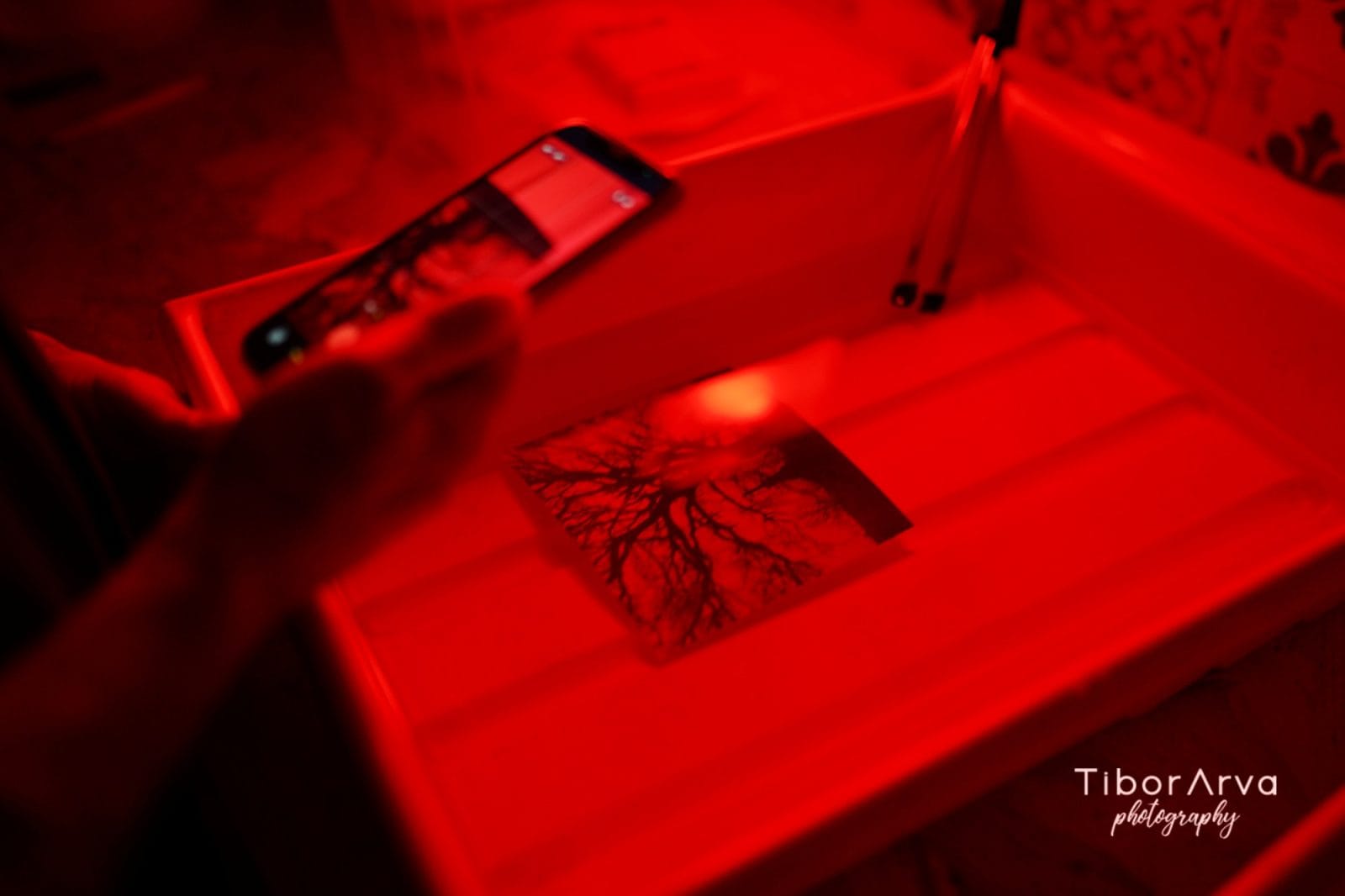
In the darkroom, time moves differently.
There are no notifications, no screens, no artificial urgency. There is only the red light, the smell of chemistry, and the steady drip of water from a tray. In this space, a photograph is not captured — it is built, one chemical reaction at a time.
Here is what happens between the moment I press the shutter and the moment a print is ready to hang on a wall.
The Negative
It begins with film. A roll of black-and-white film contains silver halide crystals — microscopic particles that are sensitive to light. When light strikes them through the camera lens, something changes in their structure. Nothing is yet visible; the image exists only as a latent impression, invisible to the eye, waiting.
In the developing tank, submerged in developer solution, those crystals begin to transform. The silver ions reduce to metallic silver, darkening where light struck strongest. What was invisible becomes visible. A negative — a reversed image — slowly emerges.
After development comes fixing: a chemical bath that removes all unexposed silver, making the image permanent and stable. The negative can now survive light.
The Print
The negative is just the beginning. To make a print, I work under safelight — a deep amber-red glow that is visible to human eyes but invisible to the photosensitive paper.
I place the negative in the enlarger — an instrument that works like a projector — and expose the silver gelatin paper beneath it for a precise number of seconds. The exposure time determines the tonal range: the depth of the blacks, the delicacy of the whites, the texture of the midtones.
Then comes the moment I never tire of.
The exposed paper goes into the developer tray. For a few seconds, nothing happens. And then, as if someone is remembering something — the image begins to appear. Slowly. A shadow first, then texture, then light. It arrives not all at once but in layers, like a story being told carefully.
This is not a metaphor. This is chemistry. But it feels like magic every time.
After development, stop bath halts the process. The fixer makes the image permanent. Multiple rinses of clean water follow — silver gelatin prints need thorough washing, sometimes for an hour, to remove all residual chemistry. Rushed washing means a print that will fade and yellow within years. A properly washed print will last a century.
Why It Matters
Each step involves a decision. The film choice, the development time, the paper grade, the exposure seconds, the dodge and burn during printing — every variable shapes the final object.
There are no sliders. There is no undo.
What comes out of the darkroom is the result of all those decisions combined, most of them made intuitively, in the red half-dark, by feel. It is craft in the oldest sense of the word.
When you hold a gelatin silver print, you are holding that whole sequence of decisions made physical. The silver that gives the print its tone is the same silver that was on the film that was in my camera. It traveled from the negative to the paper, transformed by light and chemistry and time.
That is not data. That is matter.